AI Manager: Analytics and Communication
A standalone local software suite. It implements secure email communications and intelligent routing capabilities on its own hardware. Attention! You can download and test the test version. The local production version is individually created with unique identifiers and distributed via a monthly subscription. We welcome your suggestions. Contact us on the website.
[01] CLERKAI AI SECRETARY CONCEPT // CONCEPT▼
The project originated from a practical business need within the small and medium-sized enterprise segment: to create an autonomous digital AI secretary-manager capable of intelligent search, deep web analytics, and mass personalized mailings.
The primary - ensuring data sovereignty and independence from third-party cloud providers, as stable business operations require strict confidentiality. The system architecture provides for deployment on the user's local hardware.
[02] HARDWARE REQUIREMENTS AND TESTING // HARDWARE▼
For the correct operation of AI models in autonomous mode, VRAM of 8–16 GB or more is recommended. Graphics cards with efficient cooling systems designed for a continuous 24/7 duty cycle are preferred.
In certain scenarios, consumer-grade graphics solutions with high power dissipation may not fully meet the rigid requirements of dense server racks. In its professional version, our system supports distributed computing across multiple boards (e.g., two 16 GB graphics cards), which reduces the thermal load on the chips, simplifies heat dissipation, and optimizes infrastructure costs.
Initial tests were conducted on compact models requiring up to 4 GB of VRAM. Practice has shown that models with fewer parameters are not always capable of delivering high-quality responses when solving commercial tasks. You can use lightweight models to familiarize yourself with the software interface; however, for full functionality, hardware with 16 GB or more of VRAM is recommended. If designing the hardware base from scratch, it is advisable to use server-class motherboards to allow for future scaling.
[03] ARCHITECTURE FEATURES AND OS // ARCHITECTURE▼
At the current stage, the system is developed and optimized for Windows operating systems. The development roadmap includes porting to Linux.
We deliberately avoided using intermediate abstraction layers to maintain stability in the consumer segment. Instead of integrating Linux architectures inside Windows, a Windows Native approach was chosen: the Redis DBMS was replaced with Microsoft Garnet, the Celery scheduler with the Taskiq asynchronous library, and Docker isolation with background processes. This allowed us to create an application delivered in a single executable file that efficiently utilizes local resources.
Transitioning to the target Linux architecture will enable the following technological advantages:
- vLLM and Multi-GPU Utilization: Running on Bare Metal with PagedAttention technology will allow parallel batch processing of incoming requests across multiple graphics cards simultaneously.
- Zero-Copy Technology: Direct access to kernel-level system calls reduces data exchange latency between parsing components and the neural network context.
- Console Mode (Headless): Eliminating the need to spend GPU resources on rendering a windowed interface redirects computing power to information processing.
[04] ROADMAP AND DEVELOPMENT INSTRUCTIONS // ROADMAP & ACTION▼
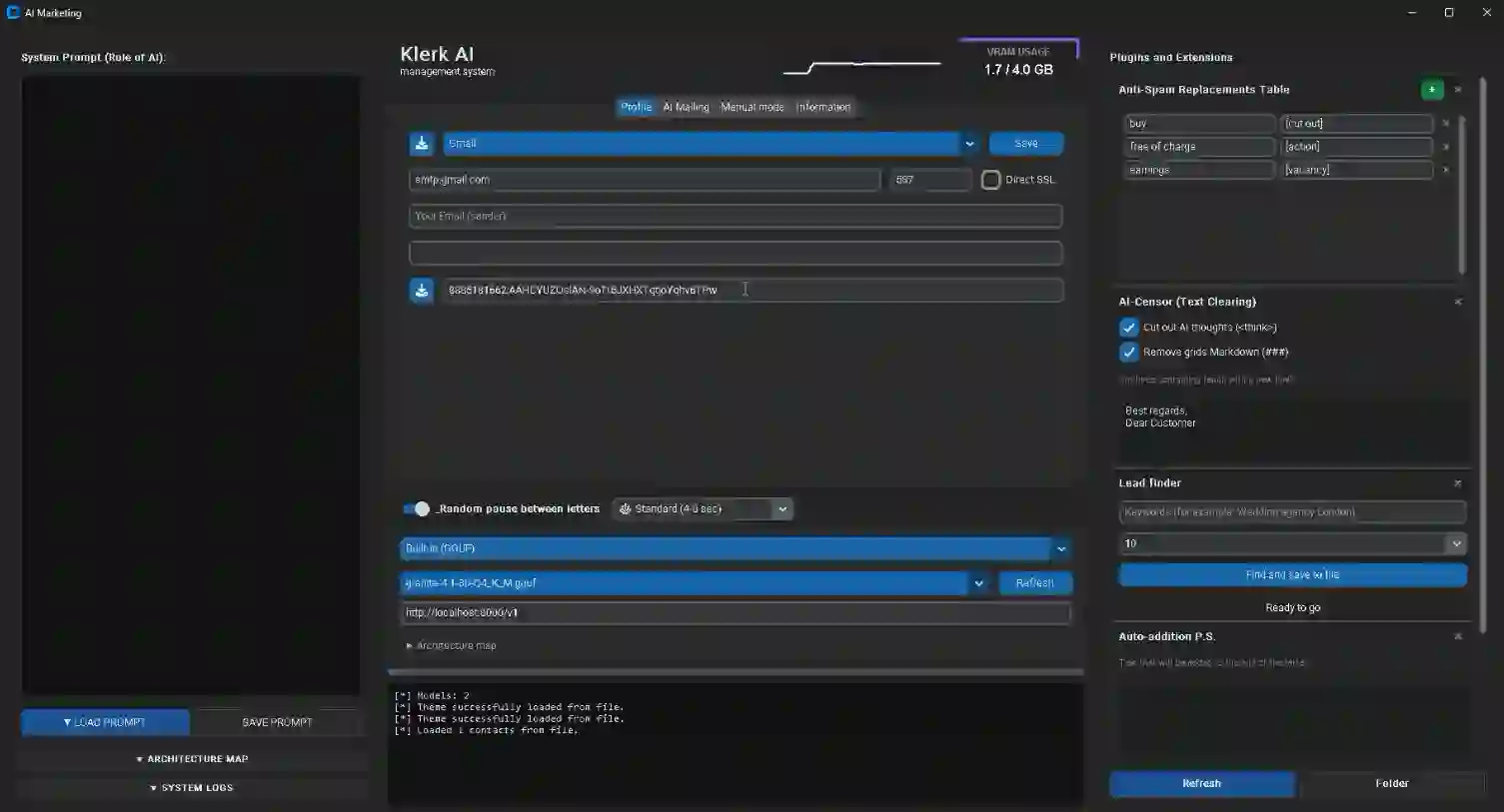
For the initial launch, simply deploy the native Windows application. In the current version, the configuration requires specifying the sender's email address, authorization data, and a list of recipients. We recommend conducting preliminary functional testing on your own mailbox before scaling tasks to production workflows.
The software architecture lays the groundwork for developing the following modules:
- Communication Channels: Subsequent integration of Telegram, Viber, and other messenger interfaces.
- Multimodal Analysis (Vision): Utilizing web drivers to capture the state of competitors' web pages, analyzed via local visual AI models.
- RAG Implementation (Qdrant/Milvus): Utilizing local vector databases to cross-reference responses with internal regulatory documents and price catalogs.
- Semantic Caching (GPTCache): Optimizing GPU load by reusing conceptually similar computation results.
- Agentic Graphs (LangGraph): Building complex decision-making scenarios for agents, with information verification through Guardrails.
You are welcome to submit feedback on the system's performance to help collectively define priority development tracks for the software product.
[VIDEO MATERIALS // MEDIA]
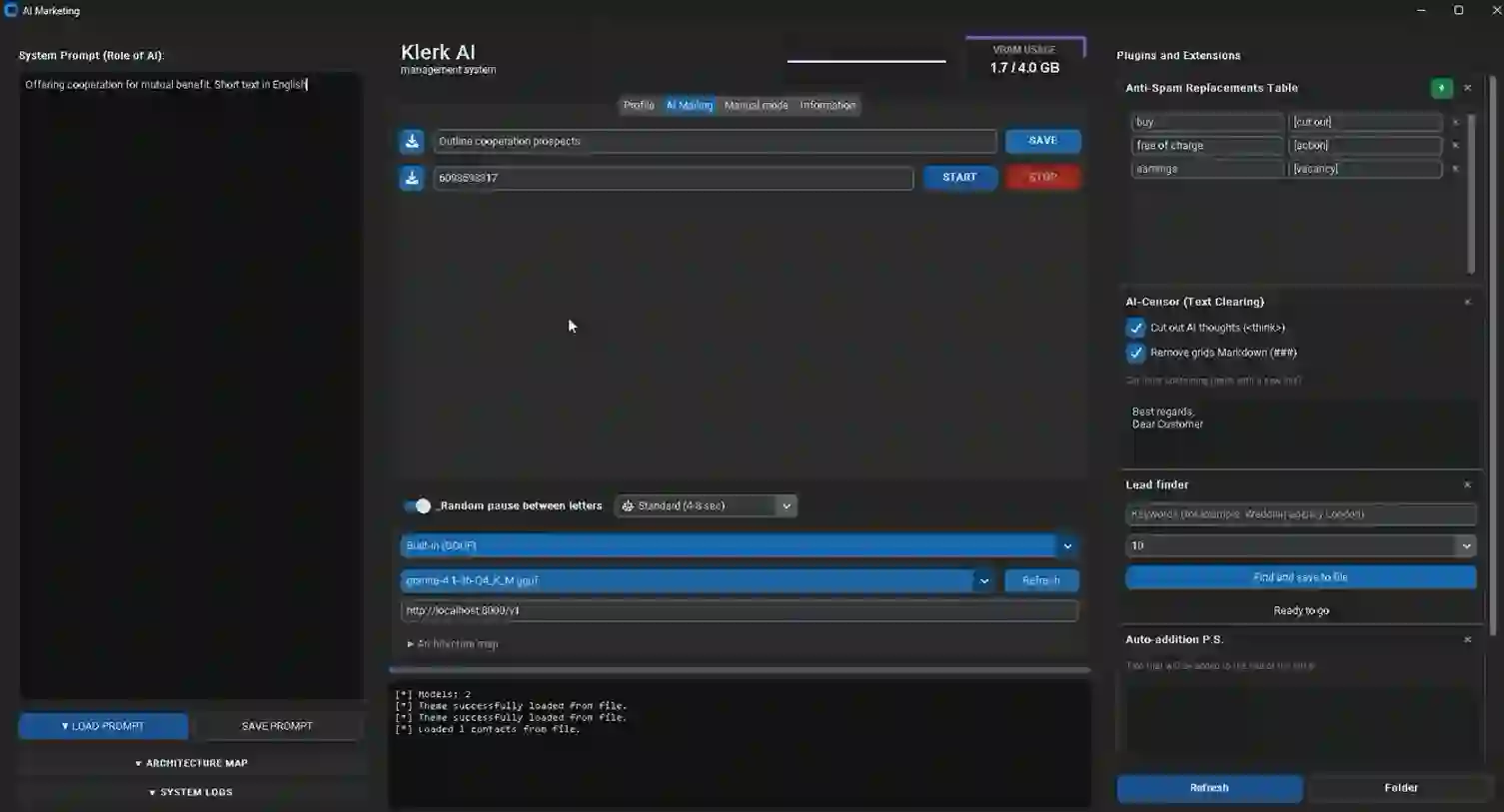
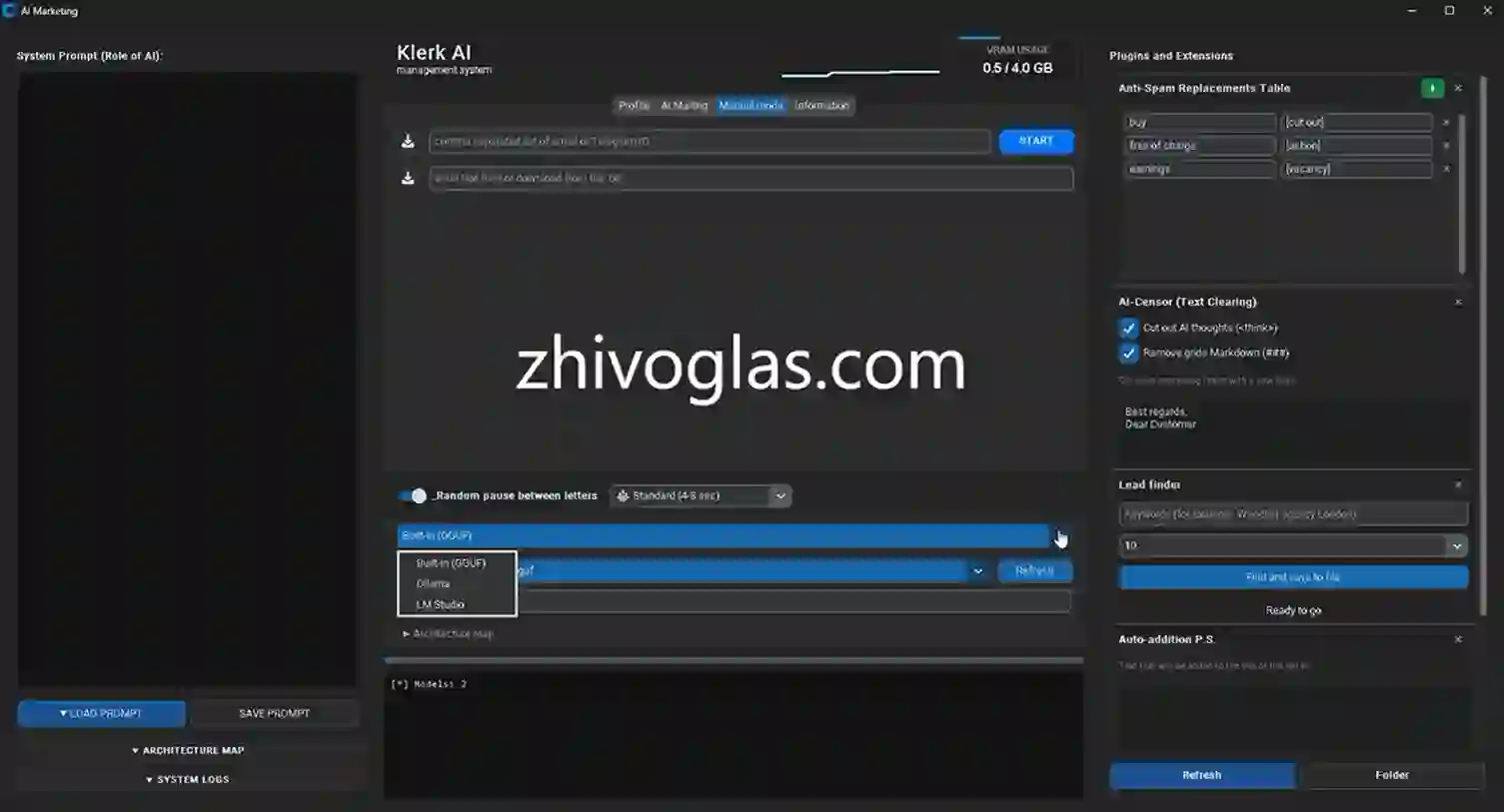
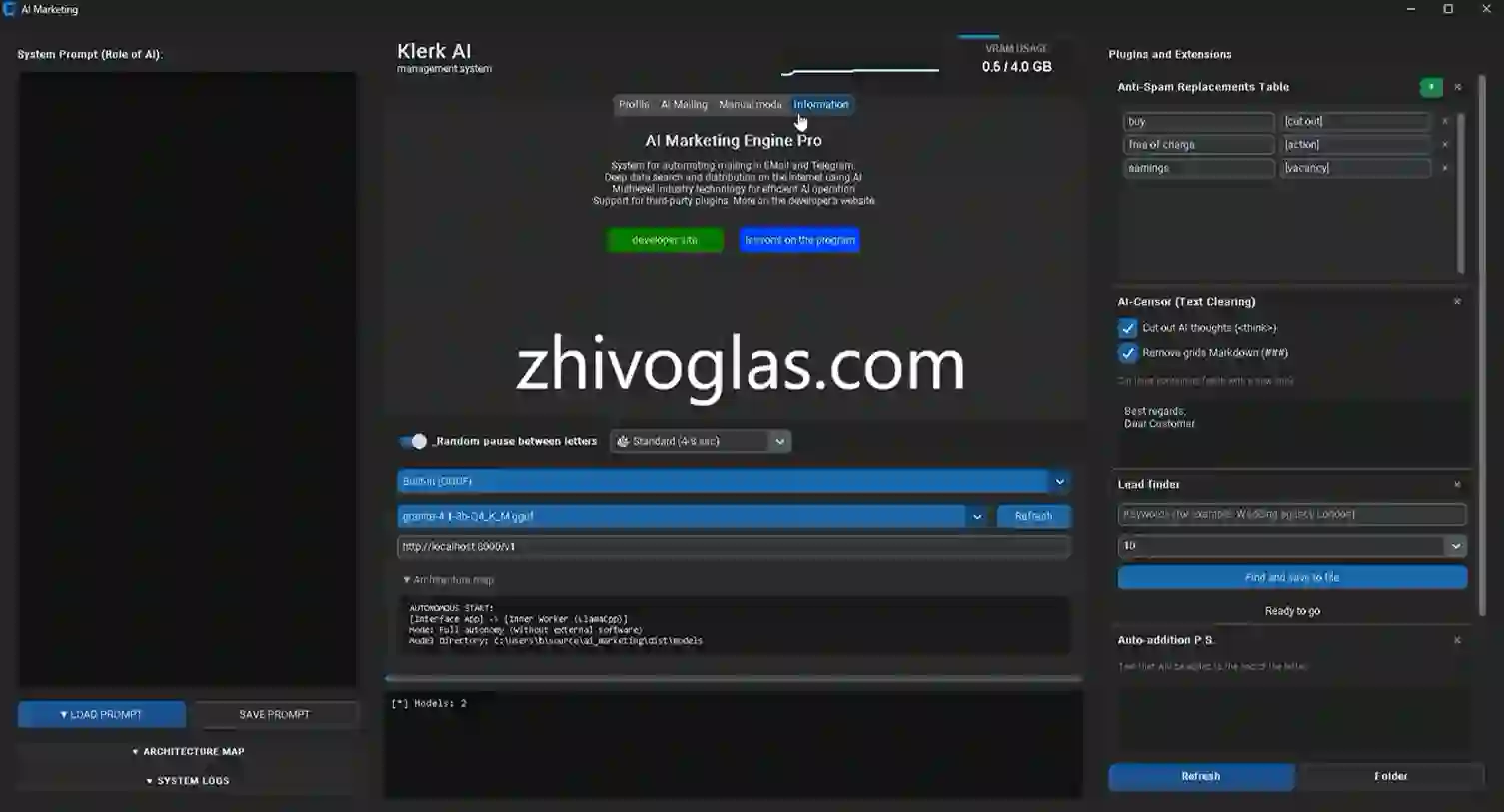
[INTERFACE GALLERY // INTERFACE PREVIEW]